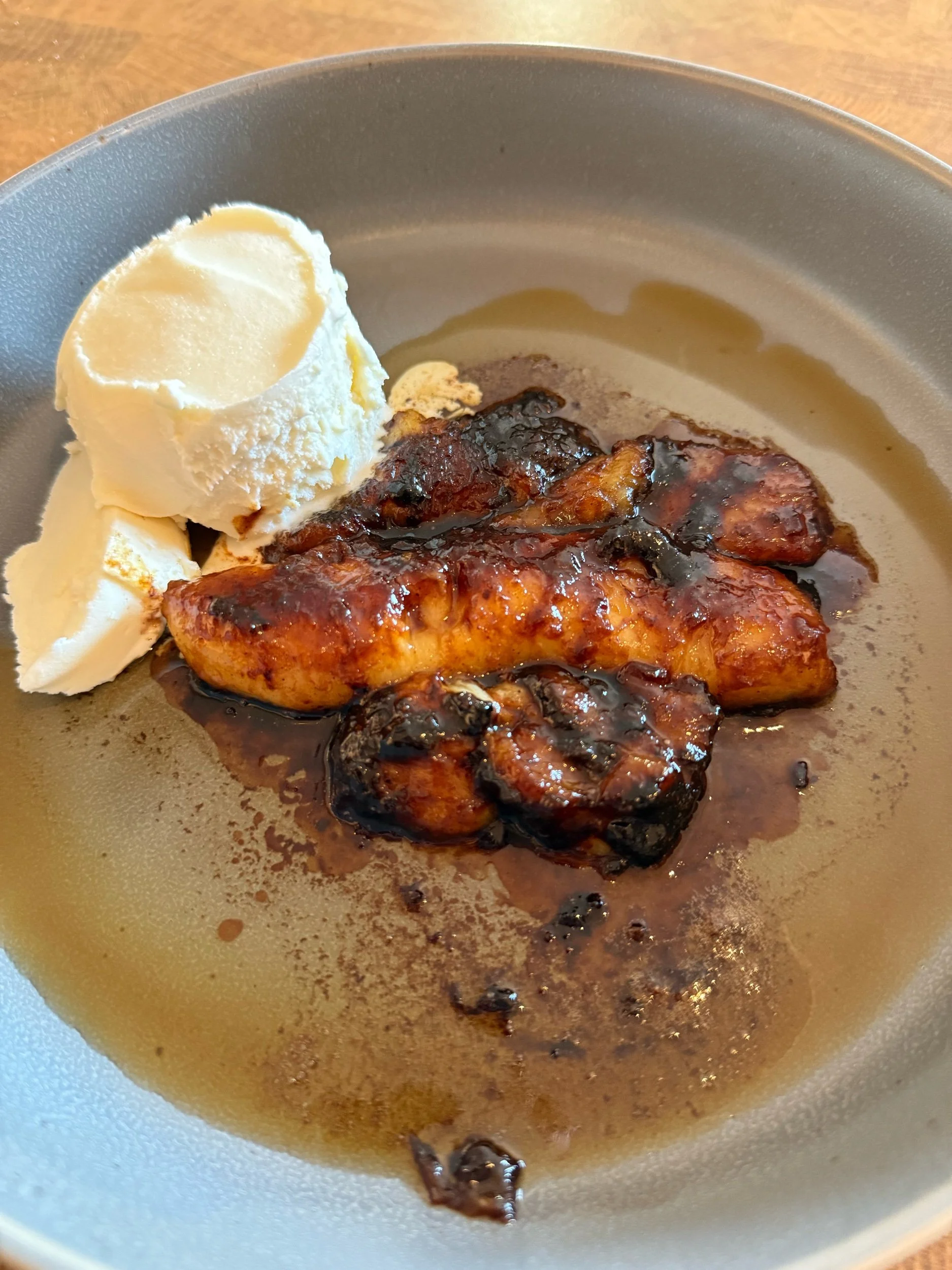
This Food in History #28 Banana Foster
Hello and welcome to today’s episode of This Food in History! Today’s food was picked as it’s one my partner loves and because a friend reminded me of it, banana fosters!
Banana fosters is a table side dessert, well associated with New Orleans, Louisiana. It makes me think of Mardi Gras, zydeco, and hurricanes. It can light up my partner’s face to see it on the menu, second only to lemon based desserts.
In the end, to no one’s surprise the dish does come from NOLA. It’s a relatively young dish as well. In NOLA, we’re going to take a jaunt down to Brennan’s Restaurant. Owen Brennan was the owner of Old Absinthe House and a Count Arnaud taunted him that Irish culinary skills only made it to boiled potatoes. Brennan wanted to prove him wrong and in 1946 opened Brennan’s Vieux Carre Restaurant on Bourbon Street.
Let’s hop to 1951. At this time, they’re in stiff competition with another local restaurant, Antonie's, that is making a baked Alaska and flaming it at the table. It is bringing a lot of visitors to their rivals. On this day, a friend of Owen Brennan is coming over. Richard Foster is the New Orleans Crime Commission Chairman. “Dick” Foster had a reputation for his work to clean up corruption in the French Quarter. Owen challenges his kitchen to create something special just for the guest. This is where story reports split.
Version A: Ti Adelaide Martin, the daughter of Ella Brennan, Owen’s sister, tells the story in Commander’s Palace, her memoir. She mentions that when Owen put down the challenge, Ella’s response was “Damn you, Owen” and into the kitchen she went. She reports that Ella grabs bananas which likely were just sitting around in the kitchen. Ella gets inspiration from a childhood dish her mother made the children for breakfast, caramelized bananas. She then paired this with the flaming idea for baked alaska. That was all it took for banana fosters to be born, and then named for the visiting friend.
Version B: Owen’s nephew Ralph tells the story slightly differently. He reports that Owen challenged the executive chef at the time Paul Blangé to make it for their guest in Southern Living.
Version C: Paul and Ella developed it together.
Either way, that fateful day led to an iconic dish for the restaurant that has been added to menus all over the world. Though its creation does have an interesting rabbit hole. The stories all tell of the bananas just laying around in the kitchen, and the restaurant’s ease of getting the produce. Why is that?
Owen Brennan was also a part owner in a Produce company. Ella and Owen’s brother John ran the business and had a surplus of bananas. NOLA was the dock that the majority of bananas imported through for the United states. The banana was not introduced to the states until a little while after the Civil War and was considered an exotic fruit. This was due to advancements in shipping, botany, and exploitation. It was brought here first from Jamaica by Captain Lorenzo Dow Baker of the schooner Telegraph. He sold them in Boston at a 1,000% profit. Bananas sold below the cost of American grown fruit which started a boom in demand. Railroad tycoons Henry Meiggs, and his nephew, Minor C. Keith established banana plantations in Costa Rica alongside their railroads to feed workers. As the enterprise grew with imports to the states, Keith established the Tropical Trading and Transport Company, half of which would become United Fruit Company (UFC) and later rebranded as Chiquita Brands International when it merged with the Boston Fruit Company started in 1899 by Andrew Preston. By the 1930s, they had control of 80-90% of the banana business in the US. However it wouldn’t stay that way.
Two major fruit companies were created and based in NOLA. The Standard Fruit Company(who would later become Dole Food Company) and Cuyamel Fruit Company. Freighters were simply bursting with bananas clogging the Mississippi River. Trains assisted in transporting them across the country.
John Brennan’s wife had ties to the Standard Fruit Company and took trips to Cuba and Honduras on Standard’s steam ships. Standard’s had a massive competitor in Cuyamel Fruit company that was founded in NOLA by Samuel Zemurray from Russia. He started buying up the overstock of ripening bananas at bargain prices and selling them locally. He used this profit to buy land in Honduras to operate his own banana plantations. This plantation like many others was rife with brutal work conditions. They had heavy loads, sweltering temperatures, tropical diseases, toxic pesticides and in one, a fungus that was killing off thousands of acres that workers were told to just work faster to outpace it.
In a loaded fact, Zemurray helped restore General Manuel Bonilla to the Honduran presidency in 1912 just to protect his personal business interests.This was not even the only government takeover that was done using the economic power and influence of these companies that also bought the US government’s power to assist in coups and more to get leaders that suited their needs. By the late 19th century, the three fruit corporations dominated the cultivation, harvesting, and exports of bananas and controlled road, rail, and port infrastructure of Honduras. The UFC was known as El Pulpo (the Octopus for the english only crowd) to the people in Honduras because of how invasive its reach was in the country.
As the 1900s continue we see the Standard Fruit Company and later Cuyamel Fruit Company joining UFC in buying land all over Central America and Caribbean islands to install more and more plantations which always paired with manipulating political power and infrastructure everywhere they went. This is the birth of the term Banana republic. For those that only know it as a clothing company (which seems an insensitive name now), a banana republic is a term for a country whose politics and economy are unstable due to economic dependency on the export of national resources. The country is operated as a private commercial enterprise for the profit of the ruling class and a very impoverished working class. The clothing company seems to have chosen its name as they travelled to such places often and the OG name was “Banana republic travel and safari clothing.”
The citizens of these countries were being exploited and given low wages and previously mentioned hazardous work conditions.
This has been a long tangent to explore the factors that lead to a banana surplus and availability that allowed Ella and Paul to come up with that dessert for Owen’s friend. Banana Fosters is a beloved dessert, NOLA staple, and one steeped in decades of history and exploitation of the Americas.
This has been This Food in History, thanks for watching, I’m Sofia, please like and subscribe for more!
Cites:
https://www.tastingtable.com/1550998/how-bananas-foster-got-its-name/
https://missionandmarketatl.com/dessert-on-fire-ignite-your-senses-with-bananas-foster/
https://www.southernliving.com/brennans-bananas-foster-history-11793702
https://www.neworleansrestaurants.com/new-orleans-recipes/recipes_brennans.php
https://www.mashed.com/826365/how-bananas-foster-really-got-its-name/
https://www.brennanshouston.com/news-item/brennans-bananas-foster/
https://www.smithsonianmag.com/smart-news/where-we-got-term-banana-republic-180961813/
https://visualizingtheamericas.utm.utoronto.ca/banana-republics-1
https://hondurasensusmanos.com/2018/08/22/cuyamel-fruit-company/