This Food in History #27 Hot Chocolate
Hello and welcome to today’s episode of This Food in History! We’ll be looking at a drink this time around and one for the cold winter months, hot chocolate! Where did it come from, why is it also called hot cocoa? All this and more in This Food in History!
The story of hot chocolate is immediately not what I expected. First off, hot chocolate came before chocolate bars. I had never really thought of this before and yet somehow it surprised me to hear that. It really felt like something that would have been turned into a drink after people were munching on the bars. So how did we get this drink?
Cocoa beans are native to Central and South America from the Theobroma cacao tree. The Mayans and Aztecs both have historical records of using the ground up seeds mixed with water, peppers,and spices to make a drink, but more recently it has been discovered that the Olmec had a drink with cocoa first. While I found various versions of the date, it seems that we’re definitely travelling back at least 3000, maybe as much as 4000 years ago to catch the Olmec preparing chocolate liquor drinks. In maybe 1800 BC or possible 1500 BC or even 2500 BC. Hayes Lavis was a cultural arts curator for the Smithsonian's National Museum of the American Indian and in an interview he provided that archaeologists aren’t able to determine exactly how the Olmec would have prepared the drinking chocolate, or if they were the first as there is no written record left. The current supposition is that they dried, fermented, roasted, and ground the cacao beans to create a drinking chocolate. There’s other evidence to say it was used in ceremonies and maybe given ritually to sacrifices.
They are supposed to have passed their knowledge to the Aztecs and Mayan who developed different methods for preparing and drinking chocolates for their cultures. Meredith L. Dreiss and Sharon Greenhill's "Chocolate: Pathway to the Gods" according to Metropolitan College's Gastronomy Blog shares that the drinking chocolate for all three would have been incredibly bitter and flavored with spices like chili and vanilla. The Olmec is also said to have frothed theirs by pouring from one container to another back and forth.
The Mayan are the next to have their drinking chocolate. I found mention that they made the beans in plantations in the Chontalpa region of what is now eastern Tabasco. Which, I did not know Mexico had a state named Tabasco. So today’s fun fact is that.
Anyway, so Mayans are grinding up the cocoa seeds, and mixing them with water, cornmeal, chili peppers and other less important ingredients that weren’t named. They would mix it by pouring it between a cup and pot over and over until it foamed up and then drink it cold.(I found one article that said Mayan’s liked it hot, while the Aztec’s liked it cold, but most mentions seem to be about it being cold.) It seems here the drink was available for all classes but the wealthy had large vessels with spouts to drink from and they were buried with these as well. They called their version xocolātl which means bitter water.
The Mayan had an annual festival dedicated to the god of cacao. There’s also temples that show gods being reborn as cacao trees. Lavis talks about how cacao was one of a few food crops used as a dowry and that evidence says in parts of Guatemala women might have been required to make the proper froth before getting married. I want to mention before we move on from the Mayans, that Honduras also has evidence of use, some consider the original known use of cacao, while Mayan graves in Guatemala had cups with the words engraved on it.
For our last stop in Mesoamerca, let’s talk about the Aztecs. The drink was a sacred drink for use in initiation ceremonies, funerals, marriages, with warriors and the beans themselves used as currency. This did prohibit poorer people from having access to the beans. Montezuma II kept a huge storehouse that was filled with tributes he demanded from conquered people. He’s said to have drunk 50 golden goblets of chocolate a day and supposedly decreed that only those men who went to war could imbibe cacao. This also limited chocolate to royals, nobles, warriors and merchants (needed for travel in hostile territories.)
They had a chocolate wafer that was pressed from ground cacao that you mix with water. This was a military ration and a spanish observer wrote on it:
“This drink is the healthiest thing, and the greatest sustenance of anything you could drink in the world, because he who drinks a cup of this liquid, no matter how far he walks, can go a whole day without eating anything else.”
While not at war, chocolate was an after dinner drink and served while smoking tobacco. The Aztecs added honey to their chocolate alongside other spices like vanilla, peppers, and more. It is said they believed it granted strength and vitality.
The Journal of Nutrition's "Food of the Gods: Cure for Humanity? A Cultural History of the Medicinal and Ritual Use of Chocolate" tells us that the Aztec believed cacao to be discovered by the gods hidden in a mountain and it was gifted to humans by the Sovereign Plumed Serpent god, Quetzalcoatl. I also found a tale that they linked it to their goddess of pregnancy Xochiquetzal. Chocolate was used as offerings to gods.
The last gift from Mesoamerica before we move on, is the word chocolate. It is supposed to derive from xocatl, with cocoa from the Aztec word caahuatl and the Mexican Indian word chocolat comes from choco which means foam, and atl which means water.
So, now that we’ve grazed the history of chocolate drinks in South and Central America, how does it lead us to the hot chocolate of today? First, let’s get cacao out of the Americas and to Europe. While we don’t seem to know exactly how, we do know about when, and the main reason. The 1500s and colonialism.
First up, the Spanish come to town and they do not come quietly. What we know is that conquistadors lead to cacao being brought back to Spain, but there are competing stories for who exactly did this. Let’s list a few:
First up is the easy guess, Hernán Cortez. It’s said Montezuma II served Cortez chocolate and he brought cocoa beans and the tools for making the chocolate drink back home to Spain. The cold and bitter drink gained popularity and King Charles V’s court and the Spanish upper class all adopted it. The Spanish adapted the drink to be served hot, sweeteners added like sugar that was brought from Jamaica and removed the chili peppers. They also were protective of it, and kept it a secret from the rest of Europe for over 100 years.
The next variant is that convicted felon Chrissy Columbus brought it back on his fourth voyage in 1502. The Spanish made changes such as heating it, adding sugar, vanilla, cinnamon, black pepper, anise and sesame as they had no access to the native ingredients such as the chili peppers, mecaxochitl, orejuleas and honey. They also had to replace the gourds used to serve it with jicaras made from porcelain. I also found mention that they started adding ambergris as well as musk, orange peel, rose water, cloves, pistachios, almonds, and egg yolks.
The last variant is that some Mayans were brought back to Spain who served it for the courts. One such record is in 1544 when Catholic missionaries returned with Mayans and gave chocolate as a gift to Prince Philip. The church went all in, and monks would drink it during services and according to some records, nuns would hand it out as well to visitors of the convents. The beverage also started competing with coffee and tea as it spread in Europe. “Chocolate was southern, Catholic, and aristocratic, while coffee was northern, Protestant and middle class.”
The thing we know for sure, was it became popular and a steady stream of cocoa beans were needed so then the Natives back in the Americas (and West Africa) were enslaved to provide it. Slaves were also needed in the Caribbean for the sugar plantations.
In 1631 we had the first hot chocolate recipe published in Curioso tratado de la naturaleza y calidad del chocolate (A Curious Treatise of the Nature and Quality of Chocolate) by Antonio Colmenero de Ledesma, an Andalusian physician. Due to the nature of his work, he focused on the psychological and physical effects of the drink. I’m pretty sure he’s a fan since in his words:
“Chocolate is healthy. It makes the drinker ‘Fat, and Corpulent, faire and Aimiable’. It was an aphrodisiac. In women it caused fertility but eased delivery, etc., etc.” with his recipe being:
“Take one hundred cocoa beans, two chillies, a handful of anise seed and two of vanilla (two pulverized Alexandria roses can be substituted), two drams of cinnamon, one dozen almonds and the same amount of hazelnuts, half a pound of white sugar and enough annatto to give some color. And there you have the king of chocolates.”
We also need the introduction of milk. Let’s start with Chocolate houses first. The first opened in 1657 and hot chocolate was selling for 50 to 75 pence a pound as a luxury item for nobility. This was about 45 to 65 pounds in 2016 inflation numbers. They were unregulated public houses that quickly became a hotbed for gambling, prostitution, and other immoral behaviors. People used it to gather and talk politics and other dangerous topics and one such place had a secret tunnel to help plotters and treasoners flee. Charles II had to put out an edict against public houses, banning the sale of chocolate, coffee, and tea.
So how milk? Sir Hans Sloane was president of the Royal College of Physicians in the late 17th century, and he visited Jamaica. He was introduced to cocoa and found it nauseous but mixed it with milk to make it more potable. He brought this back to England with him. This got it added to the after dinner list for the nobles. He started his chocolate company Sloane’s that is still in operation today. It also contributed to hot chocolate’s spread in England.
France also got their hands on it in the 17th century. It was introduced in 1615 for the marriage of Louis XIII, the son of Henry IV and Marie de’ Medici to Anne of Austra that was Infanta of Spain. Crowned in 1610 at the age of 8 and a half, Louis XIII took power in 1617. Hot chocolate became a normal drink in the court. It was touted as having fortifying, aphrodisiac, and energising virtues and consumption increased over the centuries. Louis XV was said to be the most infatuated with the drink and would make it for himself in his private apartments. Marie-Antoinette brought a personal chocolate-maker to court when she married Louis XVI and gave him the official title of Chocolate Maker to the Queen.
The New World also starts getting in on European hot chocolate around this time. The colonies are getting shipments of hot chocolate regularly. It was also a drink of the masses with even children indulging. They had a rich version, and many homes reportedly had a pot just for making hot chocolate. The chocolate was sold in bricks that needed to be shaved into a hot liquid for use. Similar to old brick style tea. Ben Franklin and others like him also touted chocolate for health benefits. He touted it as a cure for Smallpox. During the war, officers and infantry were given chocolate allotments based on rank. This was used to invigorate the soldiers, drank in the morning, and used in hospitals to aid in recovery.
Now we’re ready for the next couple evolutions of chocolate. The first is in the 19th century. Skipping over to Holland we’re going to look at Coenraad Johannes van Houten inventing cocoa powder with a press that separated cocoa butter from the cacao seeds and left behind a powder. This could then be stirred into milk or water for a purer chocolate. This also opens the door for chocolate bars. The first one was potentially created in 1847 by Joseph Fry in England by adding the cocoa butter back to the grounds and sugar to make candy.
In 1849, Cadbury started selling milk chocolate that was hot chocolate mix with cocoa powder and milk. It adapted Sloane’s recipe. By 1876, commercial milk chocolate bars were invented by Daniel Peter and his neighbor Henri Nestlé who championed powdered milk. They used the milk powder mixed with cocoa solids, and chocolate started being associated with the solid form instead of the drink.
Now, let’s talk about those health benefits of chocolate. This was something very important to the people. Chocolate was said to be a gentler alternative to coffee and almost as a tonic that people had daily for its advantages. It has caffeine which is a stimulant but in small amounts. Therobrome which is a stimulant that energizes us by activating the central nervous system, raises your mood, dilates blood vessels, lowers blood pressure, relaxes smooth muscles in the bronchi and was used as a cough medicine. Tryptophan which makes you feel good, phenylethylamine that works like an amphetamine and flavonoids which are antioxidants.
The benefits associated with chocolate consumption helped it be picked for things like the race to the South Pole by Robert Falcon Scott in 1910. He had his men drink hot cocoa 5 nights a week. And in the mornings to invigorate the men. And up until the 19th century it was used to treat stomach and liver diseases.
As we move through the 20th century, chocolate and hot chocolate have become extremely accessible. The dutch cocoa powder and original chocolate blocks are distinct means to make the drink. Of note, hot chocolate and hot cocoa are different. Hot cocoa is made from the powder that has cocoa butter removed, while hot chocolate is made from a chocolate bar that has the butter and sugar added. In WWI soldiers received cocoa powder based hot chocolate by YMCA volunteers.
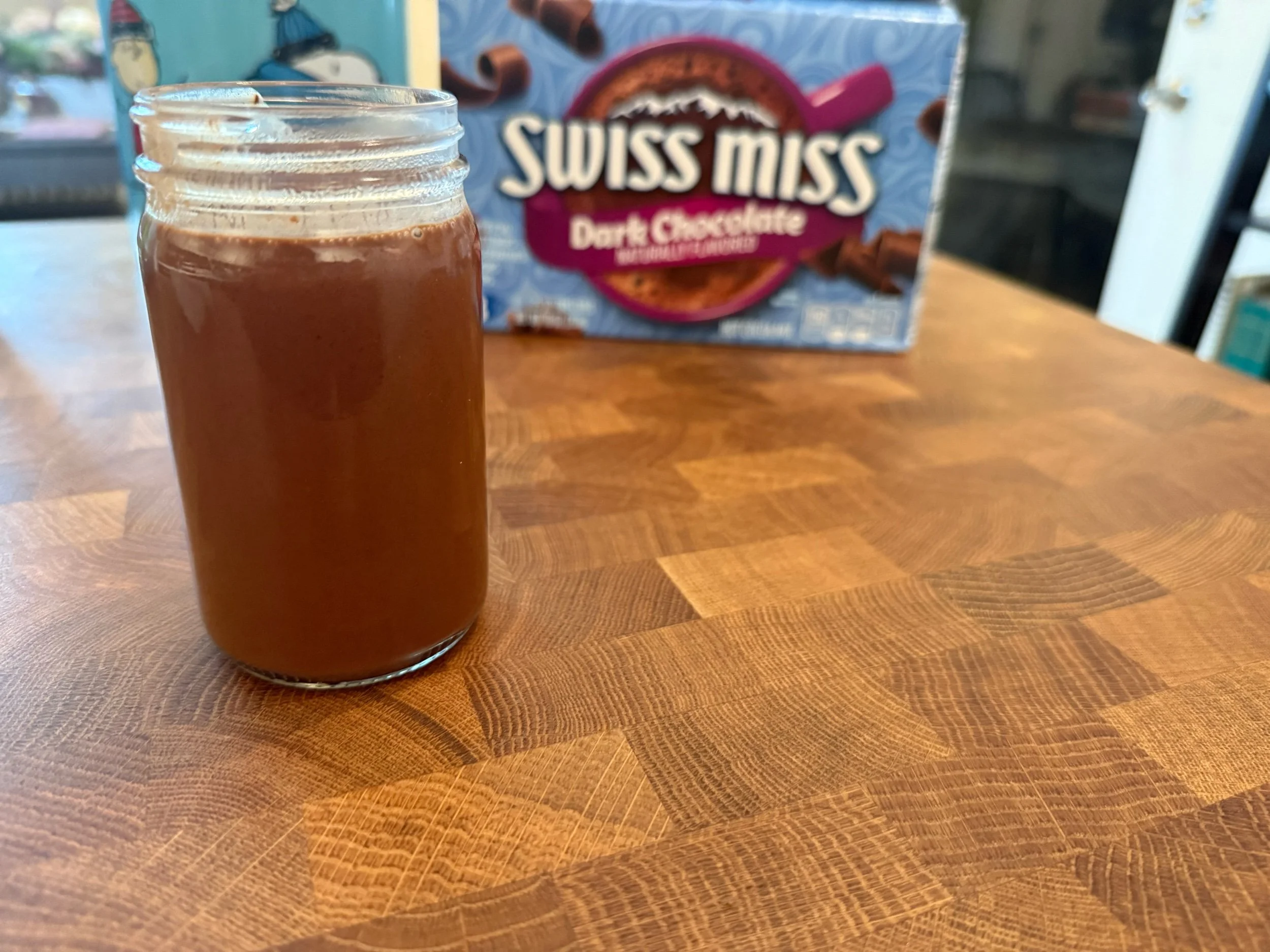
In 1961, Sanna Dairies began selling instant hot cocoa mix that would later turn into Swiss Miss. It didn’t need milk, only water. Charles Sanna was chief engineer at Sanna Dairies in Wisconsin and they had a contract with the US military, At the end of the Korean War the contract ended and they had a surplus of powdered coffee creamer. This was used to create the instant hot cocoa.
One last shout out, in 1917 the company Angelus Marshmallows wanted more sales. They dropped a recipe booklet to showcase more ways to use marshmallows and one such method was topping hot chocolate.
That’s the evolution and long winded but still only an overview of the history of hot chocolate. It can be found with variations all over the world. Italy’s famous thick hot chocolate that needs to be eaten with a spoon was said to start in 1560 to celebrate the moving of the capital of the Duchy of Savoy. In South America, thick variations with many spices and in some countries (looking at you Colombia) you add cheese. The instant versions from Swiss Miss and more companies, and old school chocolate bar versions. We find many new ways they are dressed or paired with pastry on social media with barely any effort. A gift from the gods that blessed the entire world. This has been This Food in History, I’m Sofia, thank you for watching, please like and subscribe for more!
Cites:
https://www.thespruceeats.com/the-history-of-hot-chocolate-764463
https://www.whitakerschocolates.com/blogs/blog/who-invented-hot-chocolate
https://www.artofmanliness.com/living/food-drink/the-surprisingly-manly-history-of-hot-cocoa/
https://en.chateauversailles.fr/discover/history/key-dates/hot-chocolate-versailles
https://cocoarunners.com/chocopedia/the-history-of-drinking-chocolate/
https://whatscookingamerica.net/beverage/hotchocolate-history.htm
https://www.kronchocolatier.com/blogs/news/when-was-hot-chocolate-invented-history-of-hot-chocolate
https://onipaa.org/news/smithsonian-nmai-honors-queen-lili%CA%BBuokalani
https://sites.bu.edu/gastronomyblog/2017/07/20/cacao-in-olmec-society/
https://www.mexicolore.co.uk/maya/chocolate/cacao-in-ancient-maya-religion
https://www.mexicolore.co.uk/maya/chocolate/early-history-of-chocolate
https://cocoarunners.com/chocopedia/the-history-of-drinking-chocolate/
https://www.frostmagazine.com/2014/11/hans-sloane-drinking-chocolate-review/
https://thehistorypress.co.uk/article/the-death-of-robert-falcon-scott/
https://www.simplyrecipes.com/cioccolata-calda-italian-hot-chocolate-recipe-8416565
https://www.indigenousmexico.org/articles/indigenous-yucatan-the-center-of-the-mayan-world